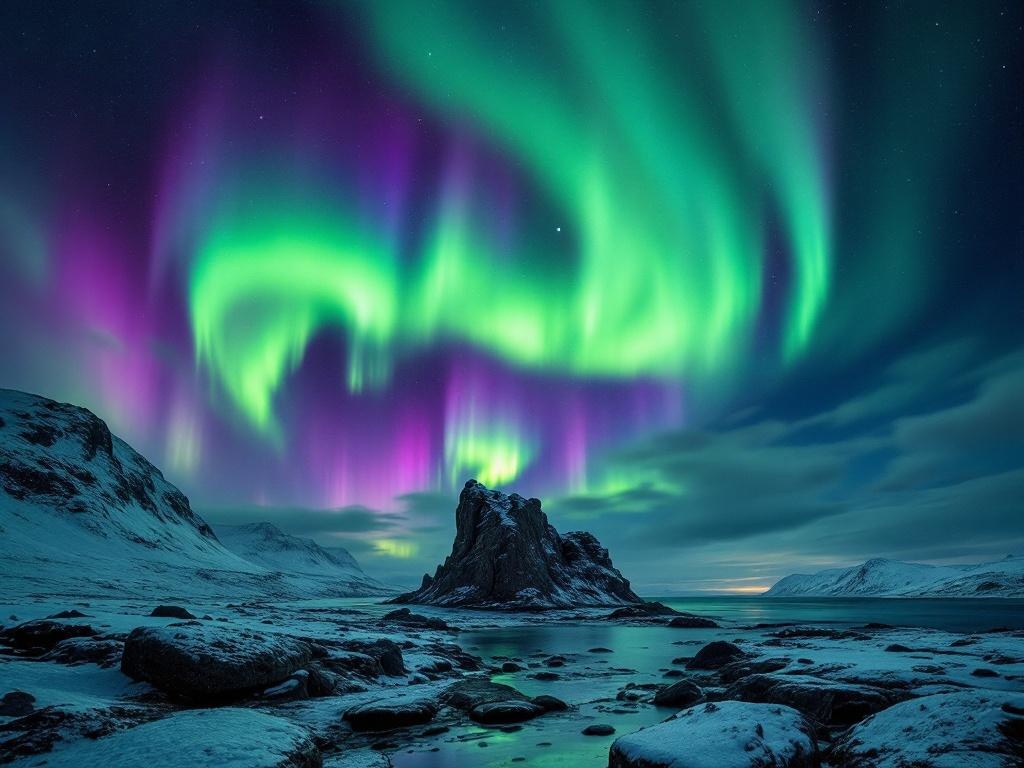
Northern Lights in the Faroe Islands: Complete Guide 2026

The Faroe Islands are one of the North Atlantic's best-kept secrets — 18 volcanic islands rising dramatically from the sea between Scotland and Iceland, with grass-roofed villages, towering sea cliffs, and some of the most spectacular coastal scenery on Earth. At 62°N, the Faroes sit further north than most of Scotland and southern Iceland, giving them a legitimate claim as an aurora destination — especially during the 2025–2026 solar maximum.
Let's set expectations: Tórshavn scores 4/10 for aurora. The Faroes are not Tromsø. The maritime climate brings frequent cloud cover, and the aurora likelihood is rated "low" for most of the winter season. But during Solar Cycle 25's peak, the increased geomagnetic activity means the Faroes are seeing more aurora displays than in normal years. And when the lights do appear over the Faroese landscape — sea stacks, waterfalls, grass-roofed churches — the combination is breathtaking.
Why the Faroe Islands for Northern Lights?

The Landscape
The Faroe Islands offer arguably the most dramatic non-Arctic landscape of any aurora destination. Think:
- Múlafossur waterfall — a waterfall that plunges directly into the ocean from a cliff edge, with grass above and sea below
- Drangarnir sea stacks — dramatic rock formations off the coast of Vágar
- Saksun — a tiny village at the head of a tidal lagoon surrounded by mountains
- Mykines — a remote island with puffin colonies and a lighthouse at the edge of the Atlantic
- Tindhólmur — a jagged, five-peaked islet that looks like a dragon's spine
Accessibility
The Faroes are surprisingly accessible:
- Direct flights from Copenhagen (2 hours), Edinburgh (1.5 hours), and several Scandinavian cities
- Atlantic Airways and Scandinavian Airlines operate year-round
- Smyril Line ferry from Denmark (36 hours) via Iceland (seasonal)
- No visa required for EU/EEA citizens or most nationalities
Mild Climate
Unlike virtually every other aurora destination in this guide, the Faroe Islands are not cold. January averages 4°C — warmer than London. The Gulf Stream keeps the islands remarkably mild year-round. You need waterproof clothing and wind protection, not Arctic gear.
The Bonus Destination
The Faroe Islands are increasingly popular for their landscapes, hiking, and birdwatching. Northern lights are a bonus rather than the primary attraction. If you're visiting the Faroes for their own sake (and you should), the possibility of aurora is the cherry on top.
Tórshavn and the Faroe Islands (Aurora Score: 4/10)
Tórshavn, the capital, is one of the world's smallest capitals with a population of about 22,000. The old town (Tinganes) with its grass-roofed red buildings is genuinely charming.
Weather: January averages 4°C with 14 hours of darkness. February 4°C with 11 dark hours. Mild but very wet and windy. The Faroes are one of the cloudiest places in the Northern Hemisphere.
Activities: Northern lights tours, puffin watching (April–August), wildlife watching (seals, seabirds, pilot whales), kayaking, hiking (world-class), photography tours, fjord cruises, and cultural experiences.
Best months for aurora: October through March. November through February for maximum darkness.
Aurora reality: The aurora likelihood is rated "low" for every month of the winter season. This means you need:
- A geomagnetic storm (Kp 4+ for visible aurora from the Faroes)
- Clear skies (challenging in the Faroes)
- Dark skies (get away from Tórshavn's light pollution)
During the 2025–2026 solar maximum, Kp 4+ events occur several times per month, significantly improving your odds compared to normal years.
Best Aurora Viewing Spots in the Faroe Islands
Away from Tórshavn
Tórshavn has enough light pollution to diminish aurora visibility. Drive 20–30 minutes in any direction for dark skies.Top Locations
- Saksun — the dramatic tidal lagoon with surrounding mountains, dark skies, excellent northern horizon
- Múlafossur viewpoint (Gásadalur) — aurora over the ocean waterfall would be a once-in-a-lifetime photo
- Vidareidi — the northernmost village in the Faroes, minimal light pollution, open northern horizon
- Tjørnuvík — beach village with sea stacks (Risin og Kellingin) as aurora foreground
- Nólsoy — small island 20 minutes by ferry from Tórshavn, dark skies, good northern views
Tips for Finding Clear Skies
The Faroese weather can change dramatically across the islands. While one island may be clouded over, another 30 minutes away may be clear. Use the local weather service (vf.telepost.fo) and be prepared to drive.When to Go
October–November: Increasing darkness. Autumn storms bring dramatic weather. Aurora possible during Kp 4+ events.
December–January: Maximum darkness (14 hours in December). Christmas in the Faroes is atmospheric. Coldest months (still only 4°C). Best statistical chance.
February–March: Improving weather. Spring equinox aurora boost in March. Still adequate darkness through early March.
Costs
The Faroe Islands are moderately expensive — similar to Iceland but slightly cheaper.
Budget (DKK 600–1,000/day | £65–110)
- Guesthouses or Airbnb: DKK 400–600/night
- Self-catering: DKK 150–250/day
- Car rental: DKK 300–500/day (essential for aurora hunting)
Mid-Range (DKK 1,200–2,000/day | £130–215)
- Hotels: DKK 700–1,200/night
- Restaurants: DKK 300–500/day
- Guided tours: DKK 500–1,000/activity
Flights
- Copenhagen to Vágar: DKK 1,000–3,000 return (£110–325)
- Edinburgh to Vágar: £80–250 return (seasonal, Atlantic Airways)
Practical Tips
Car Rental is Essential
The Faroes have excellent roads connecting the islands via tunnels and bridges. A car is essential for aurora hunting — you need to chase clear sky patches across the islands. Rent a 4WD for winter confidence on mountain roads.Waterproof Everything
The Faroes receive 1,500mm of rain per year. Waterproof jacket, trousers, and boots are more important than warm clothing. Wind protection is critical — Faroese storms can be intense.Tunnel System
The Faroes are connected by an impressive network of sub-sea tunnels. The Vágar tunnel (to the airport island) and the Eysturoyartunnel (the world's first sub-sea roundabout) make getting around surprisingly easy.Photography Tip
Even if the aurora doesn't appear, the Faroese landscape in winter is extraordinary for photography. The low light, dramatic weather, and otherworldly terrain make it a paradise for landscape photographers. Consider the aurora as a bonus, not the sole purpose of your trip.Frequently Asked Questions
Can you really see the northern lights from the Faroe Islands?
Yes, but it requires the right conditions: a geomagnetic storm (Kp 4+), clear skies, and a dark location away from Tórshavn. During the 2025–2026 solar maximum, these conditions align more frequently than usual. Treat the aurora as an occasional winter bonus rather than an expected nightly event.Is it worth going to the Faroes specifically for northern lights?
Not specifically for aurora, no. The probability is too low (4/10) to justify a trip solely for the lights. However, the Faroe Islands are an extraordinary destination in their own right — visit for the landscapes, hiking, and culture, and consider the aurora as a wonderful bonus if conditions align.What's the best time to visit the Faroe Islands overall?
For northern lights: November–February. For overall experience (including puffins and midnight hiking): June–August. For a balance of both: September–October offers aurora possibility with some remaining daylight and autumn colours.How many nights should I stay?
For aurora chances: minimum 4–5 nights to give yourself reasonable odds during strong geomagnetic activity. For the overall Faroe Islands experience: 5–7 days to explore multiple islands.Are the Faroe Islands better than Scotland for northern lights?
Yes — the Faroes at 62°N are further north than Shetland (60.4°N) and have a marginally higher aurora probability. Both destinations are in the "low probability" category, but the Faroes' latitude gives them a slight edge. The Faroese landscape is also more dramatic, though Scotland offers more accommodation options and is easier to reach from the UK.Explore our detailed guide to Tórshavn for more information about visiting the Faroe Islands.