Best Cameras for Northern Lights Photography: Budget Kits and Buying Advice
This guide is for buying a complete aurora kit without overspending. For a camera-body ranking focused on current mirrorless models, use the 2026 aurora camera ranking.
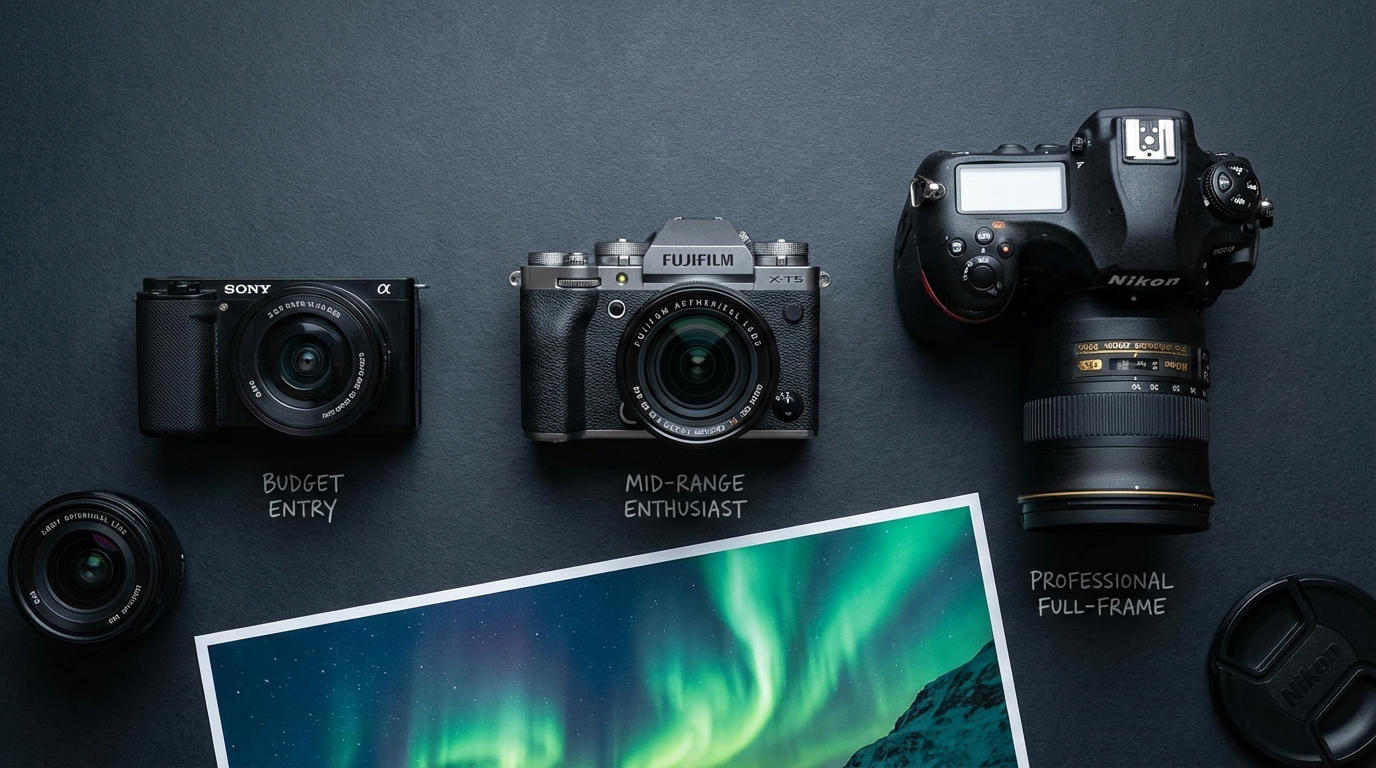
The short version: a good northern lights kit is usually camera body + wide fast lens + solid tripod + spare batteries. The lens and tripod matter as much as the body.
What Actually Matters
Aurora photography is low-light landscape photography in cold weather. Prioritise:
- Manual exposure control
- RAW capture
- Good high-ISO files at ISO 1600-6400
- A wide lens between 14mm and 24mm full-frame equivalent
- Aperture of f/2.8 or faster where possible
- A tripod that does not wobble in wind
- Batteries you can keep warm in an inner pocket
Best Complete Kits by Budget
| Budget | Sensible kit | Who it suits |
|---|---|---|
| Under $600 used | Older APS-C mirrorless or DSLR + manual wide lens + travel tripod | First aurora trip, learning manual settings |
| $800-1,200 | Used full-frame or newer APS-C + f/2-f/2.8 wide lens | Best value for most travellers |
| $1,500-2,500 | Modern full-frame mirrorless + quality wide prime or zoom | Serious hobbyists |
| $3,000+ | Weather-sealed full-frame system + premium lens + carbon tripod | Frequent polar travel and paid work |
Best Budget Body Types
Used APS-C Mirrorless
A used APS-C mirrorless body is often the best first aurora camera. It is lighter than full-frame, affordable, and good enough if paired with a fast wide lens. Look for Fuji X, Sony a6000-series, Canon EOS M/R APS-C, Nikon Z DX, or similar bodies that support RAW and manual focus magnification.
The limitation is noise at high ISO and fewer ultra-wide lens choices. For web sharing and prints, this is rarely fatal.
Used Full-Frame
Used full-frame bodies are excellent for aurora because larger sensors generally handle high ISO files better. Older Sony A7, Nikon Z, Canon R, and DSLR bodies can still produce strong aurora images.
The tradeoff is weight, bigger lenses, and higher battery drain. Buy from a reputable used dealer and budget for two or three batteries.
New Entry-Level Mirrorless
New entry-level mirrorless cameras are easy to buy and often have good screens, USB charging, and warranties. They may not outperform an older full-frame body for aurora, but they are simpler and safer for travellers who do not want used gear risk.
Lens Buying Advice
The lens is where many aurora kits fail. A slow kit zoom at f/3.5-5.6 forces higher ISO or longer shutter speeds, which can smear moving aurora.
Good aurora lens targets:
- Full-frame: 14-24mm, f/1.8-f/2.8
- APS-C: 10-16mm, f/1.4-f/2.8
- Micro Four Thirds: 7-12mm, f/1.4-f/2.8
Tripods Matter More Than Reviews Suggest
A cheap tripod can ruin an expensive camera. Arctic aurora shooting often means wind, snow, ice, gloves, and uneven ground. Choose a tripod that locks firmly, has a simple head, and can be operated with mittens.
Carbon fibre is lighter and less cold to touch, but aluminium is acceptable if the legs are stable. Avoid tiny tabletop tripods unless you are shooting from a cabin deck or snowbank.
Batteries and Cold Weather
Cold drains batteries quickly. Bring at least two spares for a dedicated camera and keep them warm inside your jacket. USB-C charging is useful, but do not rely on charging outside in sub-zero conditions.
Turn off unnecessary wireless features, reduce screen brightness, and avoid reviewing every frame for long periods. The camera may work; the battery chemistry is usually the weak point.
Are Smartphones Enough?
Modern phones can photograph bright aurora with night mode, a mini tripod, and a timer. They are useful for casual travellers and social sharing.
Phones struggle with faint aurora, detailed foregrounds, cold battery life, and print-quality files. If aurora photography is a major reason for the trip, bring a real camera or rent one.
Rent or Buy?
Rent if this is a once-in-a-lifetime trip and you want better gear than you would normally buy. Buy used if you expect to keep learning landscape photography after the trip.
Renting a fast wide lens can be smarter than buying a new body. A modest camera with a good lens usually beats an expensive body with a slow kit zoom.
Minimum Recommended Kit
- Camera with RAW and manual exposure
- Wide lens at f/2.8 or faster
- Stable tripod
- Remote release or 2-second timer
- Three batteries
- Two memory cards
- Microfibre cloth
- Headlamp with red-light mode
- Thin liner gloves plus warm mittens
Buying Mistakes to Avoid
- Spending the whole budget on the body and using a slow lens
- Buying a long zoom for aurora; you need wide, not reach
- Ignoring tripod stability
- Assuming weather sealing means waterproof
- Forgetting that small buttons are hard with gloves
- Buying a camera days before departure without practising manual focus
Bottom Line
The best northern lights camera is the one you can operate confidently in the dark, with a fast wide lens and a tripod that holds still in wind. For most travellers, the best value is a used or mid-range mirrorless body, a good f/2-f/2.8 wide lens, and more spare batteries than seems reasonable.
For current mirrorless body picks, continue to the ranked 2026 aurora camera guide.