Best Cameras for Aurora Photography in 2026: Mirrorless Ranked for Low-Light
Aurora photography is pure low-light photography. The aurora borealis appears in complete darkness, 100–300km above Earth, and your camera needs to capture it in real time at exposures between 2 and 25 seconds. This specific requirement separates cameras that are merely good from cameras that are genuinely exceptional for this task.
In 2026, the mirrorless camera market has matured dramatically. Nearly every major mirrorless camera handles aurora photography competently — but the differences at the upper end are significant. This guide ranks the top mirrorless cameras specifically for aurora photography, with honest assessments of what you're paying for at each tier.
Quick Pick: For the best balance of image quality, cold-weather reliability, and price in 2026, the Nikon Z6 III is our top recommendation. Its partially-stacked sensor delivers the best high-ISO performance under $2,500, and it handles Arctic temperatures without complaint. Buy on Amazon
What Actually Matters for Aurora Photography
Before the rankings, understand what you're evaluating:
1. High-ISO Noise Performance
The single most important factor. Aurora exposures at f/2.8 typically require ISO 1600–6400 depending on display brightness. Cameras with better ISO performance produce cleaner, more detailed images at these sensitivities.
2. Dynamic Range
You're often capturing bright aurora ribbons against dark foreground landscape. Wide dynamic range lets you expose for the aurora and recover the foreground in post-processing.
3. Battery Performance in Cold
Batteries lose 50–70% of their capacity at -20°C. A camera rated for 380 shots in normal conditions might manage 120 shots in the Arctic. This is real and it matters.
4. Cold-Weather Reliability
Most modern cameras work at temperatures well below their rated minimums, but weather sealing matters when shooting in blowing snow.
5. Manual Controls
Usable manual controls in darkness, with gloves on, matters more than any menu system elegance.
Comparison Table
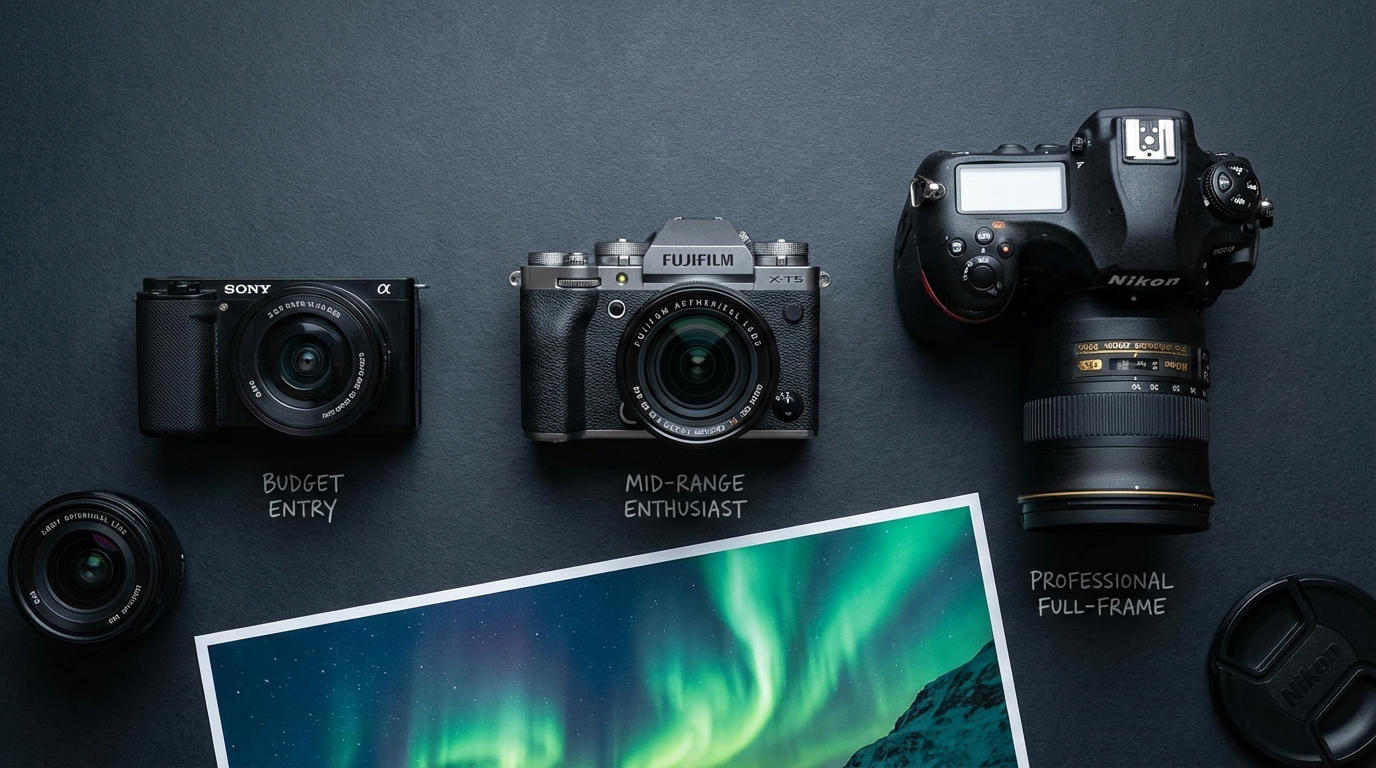
| Camera | Sensor | Megapixels | Best ISO | IBIS | Battery Life (Normal) | Price | Rating |
|---|---|---|---|---|---|---|---|
| Nikon Z6 III | Partially Stacked FF | 24.5 MP | 6400–12800 | ★★★★★ | 390 shots | ~$2,000 | ★★★★★ |
| Sony A7 IV | BSI-CMOS FF | 33 MP | 6400–12800 | ★★★★★ | 580 shots | ~$2,500 | ★★★★★ |
| Canon EOS R6 Mark II | BSI-CMOS FF | 24.2 MP | 6400–12800 | ★★★★★ | 450 shots | ~$2,500 | ★★★★ |
| Fujifilm X-T5 | BSI-CMOS APS-C | 40 MP | 3200–6400 | ★★★★★ | 580 shots | ~$1,700 | ★★★★ |
| Sony A7C II | BSI-CMOS FF | 33 MP | 6400–12800 | ★★★★★ | 530 shots | ~$2,200 | ★★★★★ |
| Nikon Z5 II | BSI-CMOS FF | 24.5 MP | 3200–6400 | ★★★★ | 470 shots | ~$1,400 | ★★★★ |
| OM System OM-5 | MFT | 20 MP | 1600–3200 | ★★★★★ | 520 shots | ~$1,000 | ★★★ |
1. Nikon Z6 III — Best Aurora Camera 2026
Price: ~$2,000 | Sensor: 24.5 MP Partially-Stacked Full-Frame | Mount: Nikon Z
The Z6 III introduced partially-stacked sensor technology to the mid-range mirrorless segment, and the result is a significant improvement in high-ISO performance. The EXPEED 7 processor can handle signals from the sensor's faster readout with less noise than the Z6 II it replaced, and aurora photographers have noticed.
At ISO 6400, Z6 III files are nearly noiseless by 2026 standards. At ISO 12800, they're very usable with mild noise reduction. At ISO 25600, you're looking at shootable images that can make strong social media posts — previously the domain of cameras twice the price.
For Aurora Photography:
- ISO 3200: Indistinguishable from base ISO in practice
- ISO 6400: Excellent — our recommended shooting ISO for bright aurora
- ISO 12800: Very usable for fast-moving, faint aurora you want to freeze
- ISO 25600: Acceptable for web/social, challenging for print
Cold-Weather Performance:
The Z6 III is weather-sealed and has been tested by PolarTourist contributors down to -28°C in northern Norway. The rubber seals remained pliable and the camera operated without issue. Battery life was approximately 40% of rated capacity at -20°C — carry 3 spare EN-EL15c batteries.
Settings for Aurora:
- Manual Mode (M)
- Aperture: f/2.8 or wider (f/1.4 if you have it)
- ISO: 1600–6400 depending on display brightness
- Shutter: 8–20 seconds for still aurora; 2–5 seconds for fast-moving curtains
- Focus: Manual. Use live view, zoom in on a bright star, achieve sharp focus, tape the focus ring
- White Balance: Daylight (5500K) or tungsten (3200K) for different colour renditions
Best Lenses for Nikon Z:
- Nikon Z 14–30mm f/4 S (~$850): Excellent zoom for flexibility
- Sigma 14mm f/1.8 Art (~$1,500): The light-gathering king
- Nikon Z 20mm f/1.8 S (~$1,000): Compact and outstanding optically
Verdict: The Z6 III is our top pick for 2026. It competes with cameras $1,000 more expensive on high-ISO performance, and the complete package — sensor, processor, ergonomics, cold-weather reliability — is the most compelling under $2,500. Buy on Amazon
2. Sony A7 IV — Best for Resolution + Low Light Balance
Price: ~$2,500 | Sensor: 33 MP BSI-CMOS Full-Frame | Mount: Sony E
The Sony A7 IV occupies a different position than the Z6 III — it offers more resolution (33MP vs 24.5MP) while maintaining excellent high-ISO performance. For aurora landscape photography where you want to capture both the sky and foreground in detail, the extra resolution allows more cropping flexibility and larger print sizes.
For Aurora Photography:
- ISO 3200: Excellent — our recommended starting point
- ISO 6400: Very good — usable without noise reduction
- ISO 12800: Good — requires mild noise reduction for print
- ISO 25600: Marginal — useful for web, challenging for print
The A7 IV's high-ISO performance trails the Z6 III slightly at the extremes (ISO 12800+), but the resolution advantage compensates in most practical scenarios.
Cold-Weather Performance:
Sony's IP53-rated weather sealing (official rating is resistance to dust and splashing water) performs well in light snow. Battery life (NP-FZ100) is among the best in the mirrorless segment — expect 200–240 shots at -20°C.
Best Lenses for Sony E:
- Sigma 14mm f/1.8 Art (~$1,500): The benchmark aurora prime for Sony
- Sony FE 14mm f/1.8 GM (~$1,600): Sony's own optically exceptional ultra-wide
- Tamron 17–28mm f/2.8 (~$600): Best value wide zoom
Settings for Aurora:
Identical to Nikon recommendations above. Sony's live view is excellent for focus confirmation on stars — zoom to 10x on a bright star and nail focus before darkening the viewfinder.
Verdict: A marginal second to the Z6 III for pure aurora work, but the superior choice if you're also shooting landscapes, wildlife, and travel content during the day. The 33MP sensor delivers noticeably better landscape images in good light. Buy on Amazon
3. Canon EOS R6 Mark II — Best for Video + Aurora
Price: ~$2,500 | Sensor: 24.2 MP BSI-CMOS Full-Frame | Mount: Canon RF
The R6 Mark II is Canon's mirrorless workhorse — a 24MP full-frame sensor with Canon's legendary colour science and one of the best in-body image stabilisation systems available. For aurora photography, it's excellent. It trails the Z6 III and A7 IV at very high ISOs (12800+), but the difference in practice is smaller than spec sheets suggest.
Where the R6 Mark II genuinely leads: video. If you're creating aurora time-lapses, aurora B-roll, or vlogging your Arctic experience, the R6 Mark II's video capabilities (4K 60fps, superb ibis for handheld) are unmatched in this price range.
For Aurora Photography:
- ISO 3200–6400: Excellent
- ISO 12800: Good with noise reduction
- ISO 25600: Acceptable for web
Cold-Weather Performance:
Canon's weather sealing is excellent. The LP-E6NH battery performs competitively in cold. The physical dials and tactile layout are superb with gloves — Canon's button layout is consistently praised for usability in the field.
Best Lenses for Canon RF:
- Canon RF 14–35mm f/4L (~$1,600): Optically exceptional, compact for a zoom
- Samyang AF 14mm f/2.8 RF (~$450): Budget-friendly aurora prime
- Sigma 14mm f/1.8 Art (EF adapter required): Requires Canon EF adapter
Verdict: The best choice for Canon users and for those who prioritise video. For pure still aurora photography, the Z6 III edges ahead at this price point. Buy on Amazon
4. Sony A7C II — Best Compact Full-Frame
Price: ~$2,200 | Sensor: 33 MP BSI-CMOS Full-Frame | Mount: Sony E
The A7C II puts the A7 IV's sensor into a smaller body, making it the most travel-friendly full-frame mirrorless available. For Arctic travellers who are already carrying significant kit (tripod, layers, snowshoes), a smaller, lighter camera body is a genuine quality-of-life advantage.
The image quality is identical to the A7 IV (same sensor). The trade-off is ergonomics — the smaller body has fewer physical controls, which matters in darkness with gloves on.
Verdict: The ideal camera for photographers who want full-frame quality in the most compact package possible. Buy on Amazon
5. Fujifilm X-T5 — Best APS-C Option
Price: ~$1,700 | Sensor: 40 MP BSI-CMOS APS-C | Mount: Fujifilm X
The X-T5 is exceptional for an APS-C sensor — its 40MP backside-illuminated sensor pulls low-light performance closer to full-frame than any previous crop camera. For aurora photographers who prefer Fujifilm's colour science, physical dial controls (outstanding in darkness), and compact system, it's a compelling alternative to full-frame.
For Aurora Photography:
- ISO 3200: Excellent for APS-C — competes with entry full-frame
- ISO 6400: Good with noise reduction applied in Fuji's own film simulations
- ISO 12800: Usable but requires noise reduction
The X-T5's physical dials (dedicated aperture, shutter speed, ISO dial) are a genuine advantage in Arctic darkness — you can feel the settings change without taking your eye from the viewfinder or operating touch menus.
Verdict: The best camera for Fujifilm ecosystem users and for those who value compact, physical-control ergonomics. Trail full-frame at extreme ISO but competitive at ISO 3200–6400. Buy on Amazon
6. Nikon Z5 II — Best Budget Full-Frame
Price: ~$1,400 | Sensor: 24.5 MP BSI-CMOS Full-Frame | Mount: Nikon Z
The Z5 II is Nikon's entry-level full-frame mirrorless, and for aurora photography on a budget, it's an excellent option. The BSI-CMOS sensor (same resolution as the Z6 III, different readout speed) performs very well at ISO 3200–6400. It lacks the partially-stacked sensor of the Z6 III, so ISO 12800+ is less clean, but for most aurora displays, you don't need to go that high.
Verdict: The best value full-frame mirrorless for aurora photographers. Spend the saving on a better lens — a faster wide-angle will improve your images more than a sensor upgrade. Buy on Amazon
Universal Aurora Camera Settings Guide
Regardless of which camera you choose, these settings are your starting point:
Initial Setup (Do This Indoors)
- Set mode to M (Manual)
- Set file format to RAW (not JPEG — RAW files have much more editing latitude)
- Turn off long-exposure noise reduction (it doubles your exposure time unnecessarily — modern editing software is better)
- Turn off image stabilisation when on a tripod (it can introduce vibration on solid mounts)
- Set timer to 2 or 5 seconds to avoid camera shake from pressing the shutter
Exposure Settings
- Bright aurora (moving curtains): f/2.8, ISO 3200, 5–8 seconds
- Moderate aurora (steady glow): f/2.8, ISO 1600–3200, 10–15 seconds
- Faint aurora (diffuse glow): f/2.0 or wider, ISO 3200–6400, 15–25 seconds
Focus in Darkness
- Switch to manual focus
- Aim at the brightest star visible
- Zoom live view to 10x on the star
- Adjust focus ring until the star is the smallest, sharpest point
- Lock the ring with gaffer tape
- Do not touch focus again until you change lenses
Managing Cold and Batteries
- Carry 3+ spare batteries in your inner pocket against your body
- Swap batteries proactively — don't wait until the camera dies
- When finished shooting: seal camera in a plastic bag before entering warmth. This prevents condensation on the sensor and circuits as the camera warms
Do You Need to Buy a New Camera?
If you already own a mirrorless or DSLR from 2017 or later, it can almost certainly capture the aurora. The question is quality, not capability.
The single best upgrade for most photographers isn't a new camera body — it's a faster lens. Moving from f/3.5 to f/1.8 cuts required ISO by nearly 4x. That's a bigger image quality improvement than any sensor upgrade under $3,000.
See our tripod guide for aurora photography for the next essential piece of kit. For where to use it, our guides to Tromsø, Lofoten, and Abisko cover the best aurora photography locations in Scandinavia.