Northern Lights Photography Tips: Camera Settings, Gear, and Techniques That Actually Work
Guide17 February 2026·10 min read

Northern Lights Photography Tips: Camera Settings, Gear, and Techniques That Actually Work

Practical, specific photography tips for capturing the northern lights — from exact camera settings and lens choices to smartphone tricks and composition techniques for stunning aurora photos.

Northern Lights Photography Tips: Camera Settings, Gear, and Techniques That Actually Work

Photographing the northern lights is simultaneously easier and harder than people think. Easier because the basic technique is straightforward — long exposure, wide lens, tripod. Harder because you're working in the dark, in the cold, with numb fingers, and the aurora is constantly moving.

This guide gives you the specific, practical knowledge to capture great aurora photos — whether you're using a dedicated camera or a modern smartphone.

Essential Gear

Camera

Any camera with manual mode and the ability to shoot long exposures (8–25 seconds) will work. This includes:

  • Mirrorless cameras (Sony A7 series, Nikon Z series, Canon R series, Fujifilm X-T series) — the best option. Electronic viewfinders work in the dark, autofocus is excellent, and sensors handle high ISO well.
  • DSLRs (Nikon D850, Canon 5D series) — still excellent. Optical viewfinders are less useful in the dark but the sensors are proven.
  • Micro Four Thirds (Olympus/OM System, Panasonic) — works well but smaller sensors mean more noise at high ISO. Still capable of great results.
Full-frame vs crop sensor: Full-frame sensors collect more light and handle high ISO better, producing cleaner images. But a crop-sensor camera with a fast lens will outperform a full-frame camera with a slow lens. Don't feel you need to upgrade — technique and lens matter more than sensor size.

Lens

The lens is arguably more important than the camera body for aurora photography.

Ideal specs:

  • Focal length: 14–24mm (full-frame equivalent). Wider is better — the aurora can span the entire sky.
  • Aperture: f/2.8 or wider. f/1.4 is exceptional. Every stop wider lets you halve your ISO or shutter speed.
  • Manual focus ring with clear markings

Recommended lenses by budget:

  • Budget (~$300–500): Samyang/Rokinon 14mm f/2.8 — manual focus only but optically excellent for the price. The most popular aurora lens worldwide.
  • Mid-range (~$700–1,000): Sigma 14–24mm f/2.8 Art, Tamron 17–28mm f/2.8 — zoom flexibility with fast aperture.
  • Premium ($1,200+): Nikon 14–24mm f/2.8, Sony 14mm f/1.8 GM, Sigma 14mm f/1.4 Art — the best of the best.
If you only have a kit lens (f/3.5–5.6): You can still photograph the aurora, but you'll need higher ISO (3200–6400+) and longer exposures (20–30 seconds), which means more noise and potential star trailing. Shoot at the widest focal length and widest aperture your lens offers.

Tripod

Non-negotiable. You cannot hand-hold an 8–25 second exposure. Period.

What to look for:

  • Stability in wind — carbon fibre absorbs vibration better than aluminium
  • Weight you're willing to carry — a travel tripod is fine if it's stable
  • A ballhead that locks firmly
  • Legs that work with gloves on

Avoid extending the centre column — it reduces stability. Hang your backpack from the centre hook in windy conditions for extra weight.

Other Essentials

  • Extra batteries × 3 minimum. Cold kills batteries. A battery that lasts 2 hours at room temperature might last 30 minutes at -15°C. Keep spares in an inside pocket against your body.
  • Remote shutter release or use the camera's 2-second self-timer — pressing the shutter button physically causes camera shake.
  • Headtorch with red light mode — white light destroys your night vision for 20+ minutes. Red light preserves it. Essential for changing settings in the dark.
  • Lens cloth — condensation forms instantly when you bring a cold camera into a warm space. Wipe before it freezes.
  • Lens hood — reduces frost forming on the front element and blocks stray light.

Camera Settings: The Starting Point

These settings work for most aurora displays. Adjust based on brightness.

For a Bright, Active Aurora

SettingValueWhy
ModeManual (M)Full control
Aperturef/2.8Maximum light gathering
Shutter speed6–10 secondsCaptures curtain structure
ISO800–1600Low noise, enough sensitivity
FocusManual, set to infinityAutofocus fails in the dark
White balance3500–4000KNatural aurora colours
File formatRAWMaximum editing flexibility

For a Faint, Diffuse Aurora

SettingValueWhy
ModeManual (M)Full control
Aperturef/2.8 or widerEvery photon counts
Shutter speed15–25 secondsLonger to gather light
ISO3200–6400Higher sensitivity needed
FocusManual, infinitySame as above
White balance3500–4000KSame as above
File formatRAWEven more important for faint subjects

Understanding the Trade-offs

Shutter speed vs. detail: Shorter exposures (3–8 seconds) freeze aurora movement, showing detailed curtain and ray structure. Longer exposures (15–25 seconds) blur the movement into smooth bands. Both are beautiful — experiment based on how fast the aurora is moving.

ISO vs. noise: Higher ISO = more visible aurora but more digital noise. Modern cameras handle ISO 3200 well; ISO 6400 is usable on full-frame bodies. Beyond that, noise becomes significant.

Stars: At 14mm on a full-frame camera, exposures up to about 20 seconds show pinpoint stars. Beyond that, stars begin to trail. The "500 rule" (500 ÷ focal length = max seconds before trailing) gives a rough guide.

Focusing in the Dark

This is where most beginners struggle. Autofocus is unreliable in near-total darkness.

Method 1: Live View on a Bright Star

  1. Switch to manual focus
  2. Point the camera at the brightest star or distant light you can find
  3. Activate live view and zoom in (digital zoom on the screen, not the lens)
  4. Turn the focus ring until the star is the smallest, sharpest point
  5. Do not touch the focus ring again. Some photographers tape it in place.

Method 2: Infinity Mark

Many lenses have an infinity (∞) mark on the focus ring. Set focus there, then take a test shot and check sharpness by zooming into the image on the LCD. Many lenses focus slightly past infinity, so the mark is a starting point, not a guarantee.

Method 3: Pre-Focus During Daylight

Focus on a distant object (horizon, mountain) during the day, then tape the focus ring. This only works if you don't accidentally bump it.

Composition: Beyond "Point at the Green Thing"

The difference between a snapshot and a compelling aurora photo is almost always composition.

Include Foreground Interest

Aurora-only sky shots get repetitive fast. The most striking images include a strong foreground:

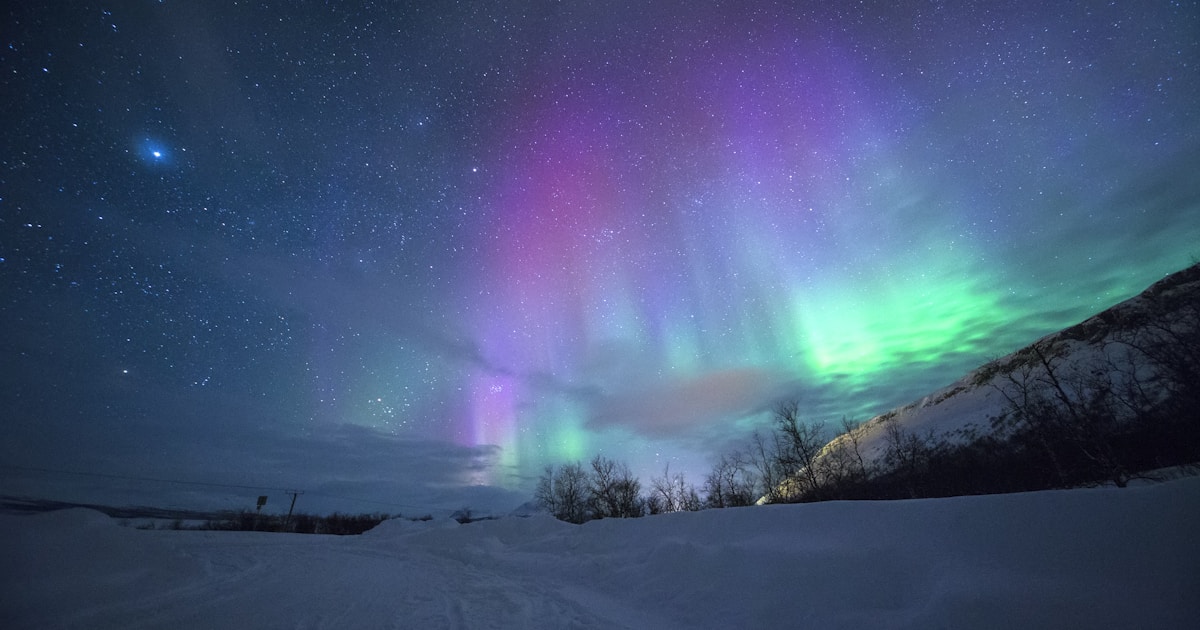
  • Reflections in calm water (fjords, lakes) — doubled aurora is spectacular
  • Silhouetted trees, cabins, or churches
  • Snow-covered mountains
  • Boats and fishing villages
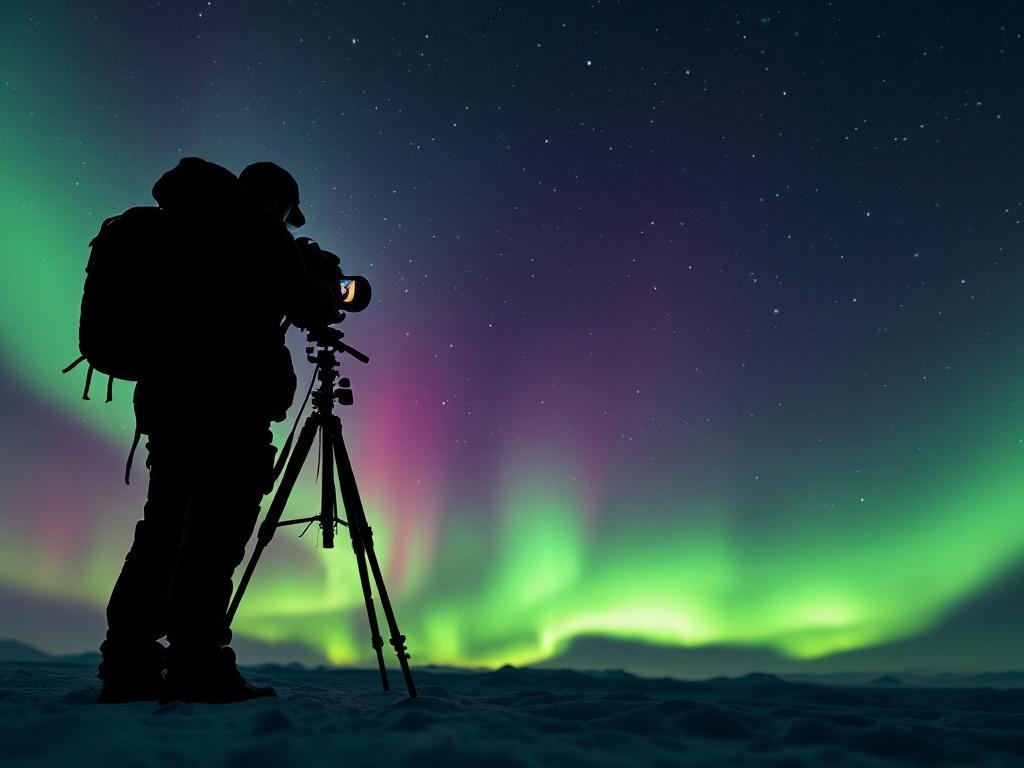
  • A human figure (self-portrait with a headtorch beam adds scale)

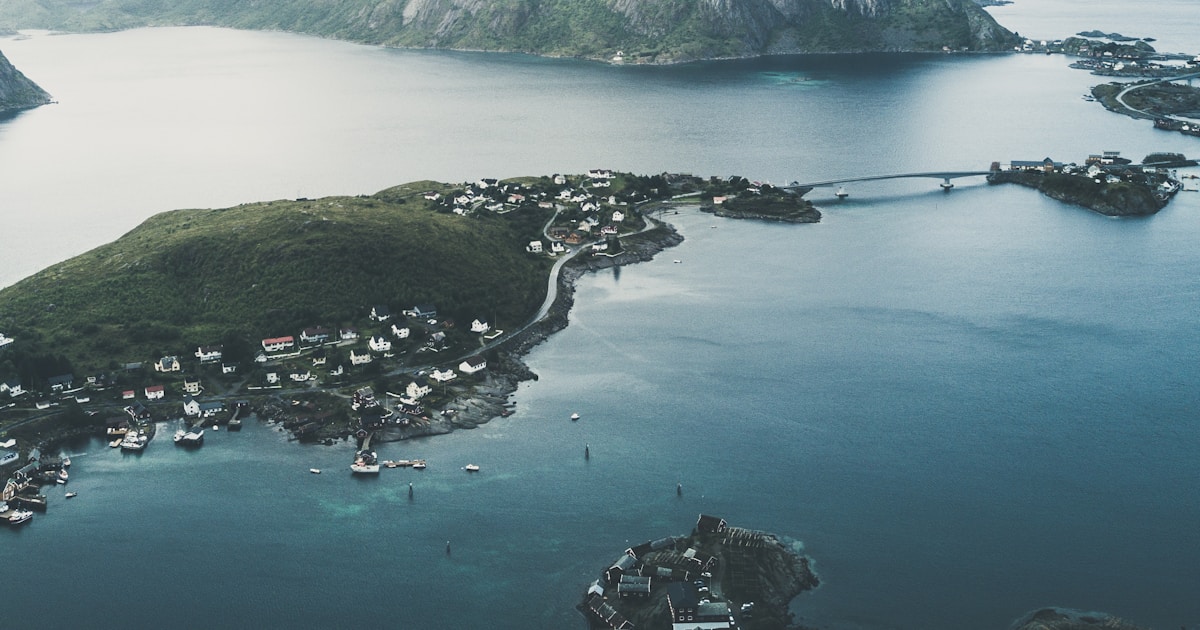
Lofoten is legendary for aurora compositions — dramatic mountains, fishing villages, and calm fjords provide endless foreground options. Senja offers similar drama with fewer photographers.

Rule of Thirds

Place the horizon in the lower third for a sky-dominant image, or the upper third to emphasise a reflective foreground. Centre horizons work when you have a perfect reflection.

Vertical vs Horizontal

Aurora curtains that reach high overhead work beautifully as vertical compositions. Wide bands across the horizon suit horizontal framing. Shoot both.

Panoramas

When the aurora spans the full sky, take overlapping shots and stitch them in post-processing. Use the same settings for all frames and overlap by 30%. Lightroom and PTGui handle aurora panoramas well.

Smartphone Photography

Modern smartphones have become genuinely capable aurora cameras. If you don't have a dedicated camera, you can still get excellent results.

iPhone (14 Pro and later)

  • Open the Camera app and switch to Night Mode (it activates automatically in low light)
  • Set the exposure to 10–30 seconds (slide the timer dial)
  • Prop the phone on something stable or use a phone tripod mount — hand-holding night mode gives blurry results
  • The computational photography combines multiple exposures and produces surprisingly good aurora images
  • For more control, use ProCamera or NightCap Camera app with manual settings

Android (Pixel 7+, Samsung Galaxy S23+)

  • Use Night Sight (Pixel) or Night Mode (Samsung)
  • Google Pixel phones are especially strong — Night Sight + astrophotography mode produces remarkable low-light images
  • Same rule: stability is everything. Use a tripod mount or prop against a solid surface.

Phone Tips

  • Turn off the flash. It's useless for aurora and will blind everyone nearby.
  • Keep the phone warm. Cold drains phone batteries even faster than camera batteries. Keep it inside your jacket and pull it out when ready.
  • Don't zoom. Digital zoom on phones degrades quality dramatically. Shoot wide and crop later.
  • Take a video too. Modern phones capture aurora movement in video surprisingly well in night mode.

Post-Processing

RAW files from aurora shoots need processing to look their best. Here's a basic workflow:

In Lightroom / Camera RAW

  1. White balance: Adjust to taste — cooler (3200K) for blue-green emphasis, warmer (4000K) for more natural rendering
  2. Exposure: Lift shadows to reveal foreground detail
  3. Contrast: Increase slightly to make the aurora pop against the sky
  4. Highlights: Reduce if the aurora centre is blown out
  5. Clarity/Texture: +10 to +30 brings out aurora structure
  6. Noise reduction: Apply luminance noise reduction (20–40) for high-ISO shots
  7. Vibrance: +10 to +20 enhances aurora colours without making them unnatural

Common Mistakes

  • Over-saturating. The temptation to crank saturation is strong. Resist it — over-processed aurora photos look fake and garish. The aurora is naturally vivid enough.
  • Over-sharpening. Creates halos and artefacts, especially visible in the smooth aurora bands.
  • Green colour cast correction. Your camera may add a green tint to the overall image. Use the HSL panel to selectively desaturate green in the non-aurora parts of the frame.

Cold Weather Camera Care

The cold is your camera's enemy. Protect your gear:

  • Condensation kills. When you bring a cold camera into a warm room, moisture condenses on and inside the lens and body. Put the camera in a sealed plastic bag before going indoors. Let it warm up slowly inside the bag. The condensation forms on the bag, not the camera.
  • Batteries: Carry 3+ charged batteries warm inside your jacket. Swap when one dies — a "dead" cold battery often has 30%+ charge left once warmed up.
  • LCD screens respond slowly in extreme cold. This is normal.
  • Touchscreens don't work with gloves. Learn the physical buttons.
  • Metal tripod legs are painfully cold to touch with bare hands. Wrap the upper leg sections with foam grip tape.

Location Scouting

Great aurora photography starts during the daytime.

  • Scout foreground elements during daylight hours. Lakes, interesting trees, photogenic buildings, mountain views.
  • Check compass direction. The aurora appears primarily to the north (in the Northern Hemisphere). Face your composition north and note where interesting foregrounds align.
  • Test compositions with daytime shots from the exact tripod position you plan to use.
  • Note access in the dark. Paths that are easy in daylight become treacherous on icy ground at midnight with a headtorch.
The best aurora photography destinations combine high aurora probability with outstanding landscape foregrounds. Tromsø and Abisko for reliability, Lofoten for dramatic foregrounds, Reykjavik and Vík for otherworldly Icelandic landscapes.

Quick Reference Card

Save this for the field:

BRIGHT AURORA:  f/2.8 | 6-10s  | ISO 800-1600
FAINT AURORA:   f/2.8 | 15-25s | ISO 3200-6400
FOCUS:          Manual → zoom live view on star → sharpest point
FORMAT:         RAW always
TRIPOD:         Always
BATTERIES:      3+ warm in jacket
COMPOSITION:    Foreground! Water, mountains, trees, people
COMING INSIDE:  Camera in sealed bag first

The northern lights are one of the most photogenic phenomena on Earth. With the right preparation and these settings as a starting point, you'll come home with images that capture the magic.

Find the best locations for aurora photography in our guides to Tromsø, Lofoten, Abisko, and Iceland.

#photography#northern-lights#camera-settings#gear#tips#aurora
HomeDestinationsActivities
Search
My Trip