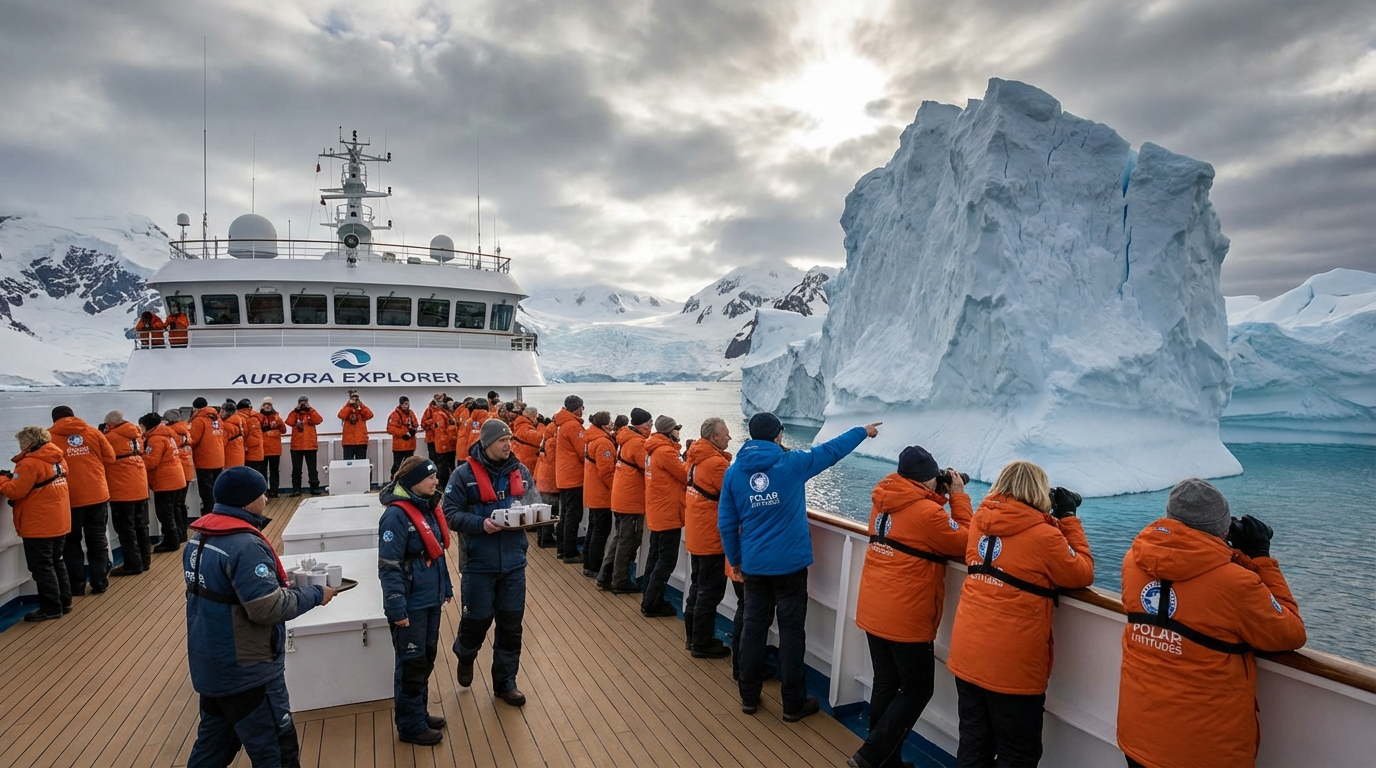
How Much Does an Antarctica Cruise Cost in 2026? (Complete Price Breakdown)
Antarctica cruise prices usually start around $7,500–$10,000 per person for a shared-cabin Antarctic Peninsula voyage and can exceed $50,000 for suites, fly-cruise departures, South Georgia extensions, or ultra-small luxury ships. The important question is not just “what is the cheapest fare?” It is whether the fare buys real expedition access: landing time, zodiac cruising, an IAATO-compliant ship size, and enough buffer for weather.
Use this guide with the Antarctica trip cost calculator, the broader Antarctica cruise route guide, and the month-by-month Antarctica season guide. The calculator helps you turn the ranges below into an all-in budget; this page explains what changes the number, including how peak January/February demand and shoulder-season November/March departures affect value.
Quick Answer: Realistic 2026 Budget Ranges
| Traveller type | Ship / cabin assumption | Realistic all-in budget per person | Watch-out |
|---|---|---|---|
| Cheapest workable expedition | Shared berth on a 150–200-passenger Peninsula ship | $10,500–$13,000 | Limited cabin choice; last-minute flexibility often required |
| Mainstream first-time trip | Twin cabin on a 100–200-passenger Peninsula ship | $15,000–$20,000 | Add insurance, hotel buffer nights, gratuities, and optional kayaking |
| Fly-cruise or premium small ship | Private cabin, fewer Drake days, stronger comfort | $22,000–$35,000 | Weather can still disrupt flights to King George Island |
| South Georgia / Falklands extension | 18–23 days, more sea time, major wildlife focus | $25,000–$45,000+ | More days means higher berth, tips, insurance, and flight-buffer costs |
| Cruise-only “see Antarctica” sailing | 500+ passenger vessel, no landings | Often cheaper than expedition ships | Do not compare it with landing-based expedition pricing |
Why Ship Size Changes the Value
IAATO visitor guidance is the key planning constraint. The general visitor rules state that only one ship may visit a site at a time, vessels carrying more than 500 passengers shall not make landings in Antarctica, and a maximum of 100 passengers may be ashore from a vessel at any one time unless a site-specific guideline is stricter. Older IAATO site guidance also describes one guide for every 20 passengers ashore.
That means ship size affects your day more than the brochure often admits:
| Vessel size | What it usually means for landing value |
|---|---|
| Under ~100 passengers | The whole ship can often rotate through landings with less waiting, subject to weather and site rules. |
| 100–200 passengers | Still a normal expedition sweet spot, but landings may run in groups. |
| 200–500 passengers | Landing operations become more constrained by rotations, site schedules, and time ashore. Check exactly how many landings and zodiac cruises are typical. |
| 500+ passengers | Cruise-only for Antarctica landings under the general restriction; useful for scenery, not for shore landings. |
The Core Cost: Expedition Berth Price
Every Antarctica trip is built around the expedition fee — the ship, cabin, meals, guides, zodiac operations, lectures, permits, and itinerary logistics.
Price by Tier (Per Person, 2026)
| Tier | Price range | Typical ship size | Cabin type | Common itinerary |
|---|---|---|---|---|
| Budget expedition | $7,500–$10,500 | 150–200 passengers | Triple/quad or obstructed twin | Peninsula only, 10–12 days |
| Standard expedition | $10,500–$15,000 | 100–200 passengers | Twin share | Peninsula, 10–14 days |
| Premium small ship | $15,000–$25,000 | 80–150 passengers | Private cabin / better deck | Peninsula with stronger guide ratio or longer time south |
| Fly-cruise / luxury | $22,000–$40,000 | 70–150 passengers | Suite or premium cabin | Fly one/both Drake crossings, higher comfort |
| Extended wildlife route | $25,000–$50,000+ | 80–180 passengers | Private cabin/suite | South Georgia, Falkland Islands, Ross Sea, or special access |
What's Usually Included
For most expedition operators:
- accommodation aboard the ship
- all meals on board
- non-alcoholic drinks, sometimes with exclusions
- zodiac landings and cruises when conditions permit
- expedition lectures and guiding
- parka, and sometimes waterproof boot loan
- port fees, environmental levies, and required permits where stated
What's Usually Not Included
- flights to Ushuaia, Punta Arenas, Hobart, or another gateway
- hotel nights before and after the voyage
- travel insurance with emergency evacuation cover
- alcoholic drinks, premium drinks, laundry, and satellite internet
- kayaking, camping, mountaineering, diving, helicopter, or photography add-ons
- gratuities for crew and expedition staff
- baggage fees or extra hotel nights if weather delays a fly-cruise
All-In Cost: What You Actually Spend
The base fare is only one line in the budget. A realistic Antarctica budget includes gateway flights, buffer nights, insurance, gear, gratuities, optional activities, and contingency.
Flights to the Gateway City
Most Antarctic Peninsula expeditions depart from Ushuaia. Fly-cruise trips usually stage through Punta Arenas. Some Ross Sea or sub-Antarctic itineraries depart from Hobart, New Zealand, or Cape Town.
Typical planning ranges:
- Europe to Buenos Aires or Santiago, then Ushuaia/Punta Arenas: $1,000–$2,000 return
- North America to Buenos Aires or Santiago, then domestic connection: $900–$1,800 return
- Australia/NZ to South America or Hobart departure positioning: $1,000–$2,500 depending on route
Hotel Buffer Nights
Arrive at least one full day before embarkation; two nights is safer for long-haul travellers. Ushuaia and Punta Arenas are small enough that rooms can tighten around ship departure days.
Planning range:
- budget guesthouse/hostel: $40–$80 per night
- mid-range hotel: $90–$180 per night
- boutique lodge or high-demand dates: $180–$300+ per night
Insurance and Evacuation Cover
Do not treat insurance as optional. Antarctica is remote, medical evacuation is difficult, and operators usually require travel insurance that covers emergency evacuation and expedition activities.
Planning range: $400–$900 per person for a 2–3 week trip, depending on age, residence, trip cost, cancellation cover, and activity cover.
Check the policy wording for:
- emergency medical evacuation amount
- Antarctica / polar region coverage
- cruise and expedition activity exclusions
- kayaking, camping, diving, or mountaineering exclusions
- cancellation cover that matches the non-refundable trip cost
Gratuities
A common planning range is $15–$25 per person per day unless the operator includes gratuities. For a 12-day voyage, that is roughly $180–$300 per person; for an 18–23 day South Georgia trip, it can be $270–$575.
Optional Activities
| Activity | Typical planning range |
|---|---|
| Sea kayaking, single outing | $200–$350 |
| Sea kayaking, full voyage programme | $500–$1,000 |
| Camping overnight on ice | $250–$500 |
| Mountaineering / snowshoe add-on | $300–$700 |
| SCUBA or specialist diving | $400–$800+ per dive/day |
| Helicopter flightseeing where available | $400–$700+ |
| Stand-up paddleboarding | $150–$300 |
Gear
Most expedition ships provide a parka and waterproof boots, but policies vary. You still need warm layers, waterproof trousers, gloves, a hat, neck gaiter, sunglasses, and usually binoculars.
If you already ski or winter-hike, budget $150–$400 for missing pieces. If starting from scratch, $500–$1,200 is more realistic. See the Antarctica packing list before buying specialist items.
All-In Cost Examples
Budget Expedition: About $10,500–$13,000 per person
- shared-cabin Peninsula berth: $8,500
- flights and domestic connections: $1,300
- hotel buffer nights: $250
- insurance: $500
- gratuities: $225
- gear top-up: $300
- incidentals: $300
- contingency: $500
Mainstream First Antarctica Trip: About $16,000–$20,000 per person
- twin-cabin Peninsula berth: $12,500
- flights: $1,600
- hotel buffer nights: $450
- insurance: $650
- gratuities: $275
- kayaking or camping add-on: $700
- gear: $500
- incidentals and contingency: $800
Premium / Fly-Cruise Trip: About $25,000–$38,000 per person
- premium cabin or fly-cruise berth: $22,000–$30,000
- flights: $2,000–$3,500
- hotel buffer nights: $600–$1,000
- insurance: $800–$1,200
- activities, tips, and gear: $1,500–$2,500
South Georgia / Falklands Wildlife Trip: About $28,000–$45,000+ per person
- longer expedition berth: $24,000–$38,000+
- flights and gateway logistics: $1,500–$3,000
- insurance: $900–$1,500
- tips over a longer voyage: $350–$600
- hotel, gear, and contingency: $1,500–$3,000
How to Reduce the Cost Without Buying the Wrong Trip
1. Compare Landing Value, Not Only Fare
A lower fare on a larger vessel can be good value for scenery, lectures, and comfort. It is not the same product as a small expedition ship with frequent landings. Before booking, ask for the planned passenger count, typical landing rhythm, zodiac cruise policy, and whether the ship is cruise-only in Antarctica.
2. Choose the Antarctic Peninsula First
The classic 10–12 day Antarctic Peninsula route is the cheapest true landing-based Antarctica trip. Adding South Georgia, the Falkland Islands, or the Ross Sea adds days and cost.
3. Use Last-Minute Deals Carefully
Last-minute discounts can be real, especially outside Christmas/New Year and on unsold shared cabins. They work best if you can travel with days or weeks of notice, accept limited cabin choice, and handle flight risk.
Do not rely on last-minute deals if you need a specific ship, kayaking space, South Georgia routing, or holiday-period departure.
4. Share a Cabin
Solo travellers can often book a single berth in a shared cabin and avoid the 25–50% single supplement for private occupancy. Check whether the operator matches by gender, whether bathrooms are shared, and how cabin changes are handled.
5. Pick the Right Month
- November: cleaner snow, early-season ice, penguin courtship, sometimes better availability
- December–January: peak light and demand, often highest fares
- February: strong whale activity and still broad access
- March: late-season light and whale interest, often better deal potential
2026–2027 Booking Questions to Ask
Before paying a deposit, ask the operator or agent:
- How many passengers are on this departure?
- Is the ship landing-capable in Antarctica, or cruise-only?
- How are landing groups rotated when only 100 passengers can be ashore?
- What is the realistic number of landings and zodiac cruises on this route?
- What is included: parka, boots, port fees, IAATO/environmental levies, gratuities, drinks, charter flights?
- What happens if a fly-cruise flight is delayed by weather?
- Which optional activities are capacity-limited and how early do they sell out?
- What insurance minimums and activity cover does the operator require?
- Are fuel surcharges or currency adjustments possible after deposit?
- What cancellation terms apply if illness, flight delay, or weather prevents arrival?
Use the Calculator Before You Compare Deposits
Once you have a rough ship type and route, run the numbers in the Antarctica trip cost calculator. Put in the cruise fare, gateway flights, buffer nights, insurance, tips, gear, and optional activities. The all-in number is the one to compare — not the headline berth price.
If the total feels too high, the safest cuts are usually cabin category, departure month, optional activities, and route length. The riskiest cuts are insurance, arrival buffer nights, and choosing a cruise-only ship when what you really want is a landing-based expedition.